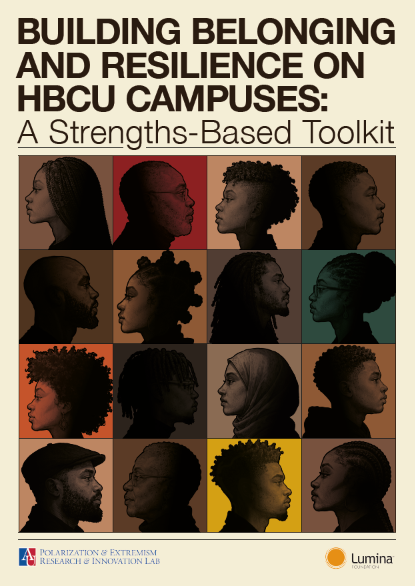
Developed with Howard University partners and supported by the Lumina Foundation, “Building Belonging and Resilience on HBCU Campuses: A Strengths-Based Toolkit” analyzes the unique strengths of Historically Black Colleges and Universities (HBCUs) to foster genuine belonging, drawing on the rich assets and legacy of HBCUs.
HBCUs have been uniquely positioned to prioritize their students’ wellbeing and sense of belonging given that they were founded to serve African Americans who were denied access to other institutions. With that foundational mission, the groundwork of community building is woven into HBCU culture.
Relevant for all higher education institutions, the toolkit highlights 11 evidence-based core strengths-building areas that foster belonging on HBCU campuses and highlights challenges and solutions for extending that culture of care to all students equitably on campuses:

Recognizing that everyone on campus creates belonging, the toolkit presents role-specific actions and recommendations to administrators, faculty, staff, and students to highlight the most important ways to expand inclusivity on campus to all student groups and identities.
To learn how your institution can take meaningful action today, download the resource here.
Bring the toolkit to life by attending a free webinar with the Center for HBCU Research, Leadership, and Policy at Howard University. Each session pairs findings from the HBCU Campus Climate Study with the toolkit strategies that respond to them.
The series opens with a virtual launch panel on Monday, November 9, 3:00–4:00 PM ET. Register here for a webinar in the series.
This toolkit is a collaboration between PERIL and Dr. Sosanya Jones, Dr. Randy Bumpers, and Jody Dixon from Howard University. It is the most recent resource developed as part of PERIL’s Building Resilient & Inclusive Communities of Knowledge (BRICK) project, funded by the Lumina Foundation, which includes A Deeper Look at Hispanic Serving Institutions and Going Mainstream: Male Supremacy, the Manosphere, and Implications for Higher Education. It centers the distinctive landscape of Historically Black Colleges and Universities (HBCUs) while speaking directly to the practitioners who do this work: students, student leaders, faculty, staff, and administrators.
The literature review of sources on HBCU campus climates made evident 11 “Strength-Building Areas” which holistically address inclusivity and community growth at HBCUs:
All members of HBCU communities can play a part in all strength-building areas, but the toolkit maps which groups lead and which support each area.
The toolkit was made to support students, student leaders, administrators, faculty, and staff at HBCUs working to bring about lasting change in expanding inclusivity on their campuses.
To enable that implementation, the toolkit provides a list of recommendations for each community stakeholder group, with concrete steps for putting the findings into practice.
Additionally, a series of reflection questions are also provided to support next steps and to determine relevant parameters for implementation.
Interested in a customized training session at your institution or organization? Reach out to PERIL at: [email protected].
Enter your email address to find out about new research, reports and toolkits to help reduce polarization and extremism.